


Company brochure design for B2B buyers
Good company brochure design answers a procurement manager’s questions in order: who you are, what you do, who you have done it for, what makes you different, and how to start. Every page should look like the rest of your brand, from logo to colours to the vehicles that deliver your service.
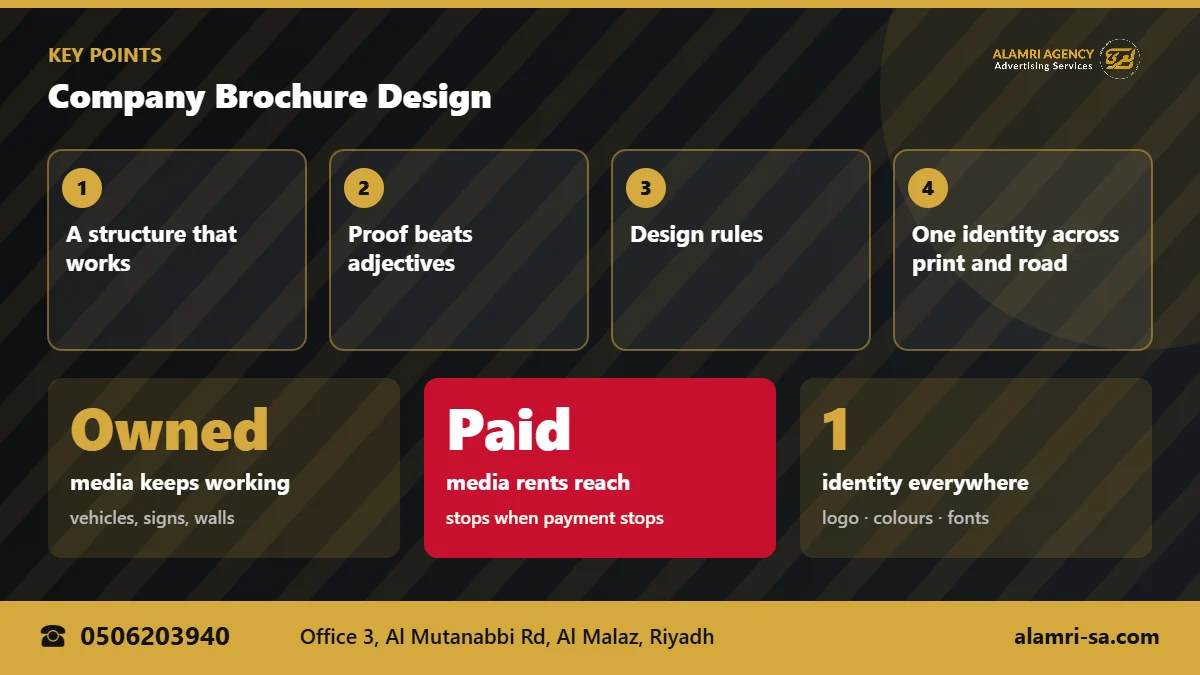
A structure that works
- Cover: name, one-line promise, strong image.
- Who we are: years in business, location, specialisation.
- Services: short, scannable sections.
- Proof: client sectors, results, real project photos.
- Difference: what you do that others do not, stated with numbers.
- Next step: phone, WhatsApp, email, address.
Proof beats adjectives
“High quality” means nothing to a buyer. A fact does. For example, our own approved figures read like this: one installation that lasts up to 5 years instead of 2–4 installations, and a 30-month written warranty on 3M. Specific claims you can stand behind are what make a brochure credible.
Design rules
- Use your exact logo files and brand colours.
- Keep fonts consistent with your signage and vehicles.
- Real photos of your work outperform stock images.
- One message per page.
Talk to us. Want your brand to look the same on every vehicle and wall? Tell us what you are planning and we will suggest where to start.
Stand out with Al Omari Agency · Al Omari Agency on YouTube
One identity across print and road
A brochure that promises consistency should be backed by a consistent presence. For the Ministry of Environment, Water and Agriculture we branded 90 vehicles with 3M inside and outside Riyadh after their previous supplier had not kept them consistent.
Frequently asked questions
Printed or digital brochure?
Both. A PDF for email and a printed version for meetings and exhibitions.
How long should a B2B brochure be?
Long enough to answer the buyer’s questions, usually a few pages. Cut anything that is not proof or a next step.