



Indoor vs outdoor printing: why it decides your sticker’s life
The difference between indoor vs outdoor printing is the main reason fleet stickers fail early. Most fleet stickers in Riyadh burn and peel within 8–12 months because they are printed for indoor walls, not for a vehicle in the sun. At Al Omari Agency we use printing designed for the outdoor environment on original 3M or ORAFOL material, rated for up to 5 or up to 3 years.
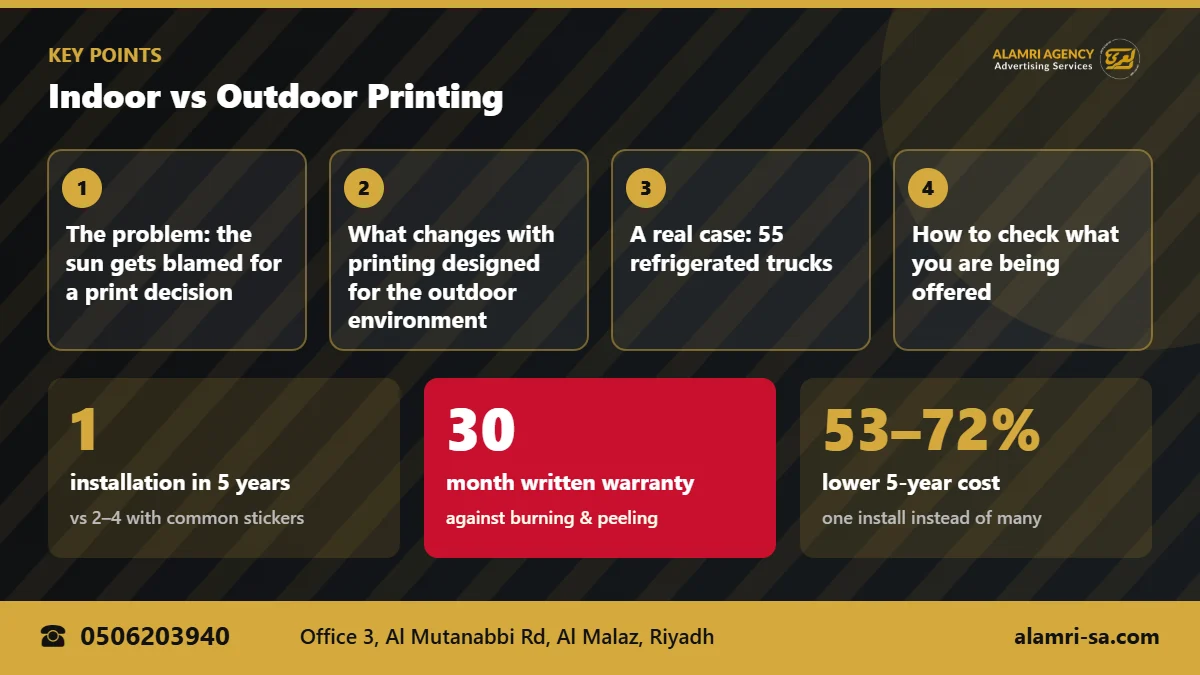
The problem: the sun gets blamed for a print decision
When a fleet manager sees faded colours and lifting edges after one summer, the natural conclusion is “Riyadh’s sun is too strong.” In our experience, the sun only reveals the problem. The cause was decided earlier, when the supplier chose a print type made for indoor walls because it is cheaper, then installed it on a vehicle that spends all day outside.
The result is a cycle many companies know well: the sticker burns, the logo looks damaged on the street for months, and the company pays for the whole project again. Each re-installation also takes vehicles off the road.
What changes with printing designed for the outdoor environment
We describe our method in one phrase only: printing designed for the outdoor environment. It is paired with original material, and the material name is written in the quotation:
| Material | Rated life | Written warranty | Our recommendation |
|---|---|---|---|
| Original American 3M | Up to 5 years | 30 months | Every fleet |
| Original German ORAFOL | Up to 3 years | 16 months | Lower budgets |
The warranty covers burning (colours that yellow and distort the ad) and peeling (the sticker separating or tearing at the edges). If either happens within the warranty period, we reprint and reinstall at our own cost.
A real case: 55 refrigerated trucks
Domino’s Pizza (Al Amar company) runs 55 refrigerated trucks in Riyadh. They had tried a supplier that sold a “protective layer” at a higher price, and the stickers still burned in less than a year. We installed the whole fleet with ORAFOL, our second material, in less than a month, in batches, without stopping their work. Fourteen months later: zero burning and zero peeling.
The lesson for buyers: a coating on top cannot fix a print that was never made for the outdoors.
Talk to us. Send us your vehicle count and how long they will stay in service, and we will send a 5-year cost comparison based on your own fleet numbers.
Designs that reflect your identity, materials made for our climate · Al Omari Agency on YouTube
How to check what you are being offered
- Ask the supplier to name the material brand in the quotation, not just “high quality vinyl”.
- Ask whether the print is made for outdoor use. A vague answer is an answer.
- Ask for the warranty in writing, with the defects it covers named.
- Ask what happens on day one of a claim: who reprints, who reinstalls, who pays.
Before you sign with any supplier, ask: do you guarantee your stickers for 30 months in writing?
Frequently asked questions
Is indoor printing ever fine for vehicles?
Not for a fleet that works outdoors every day. Indoor printing belongs on indoor walls and displays. On a vehicle it is the most common reason stickers burn and peel within a year.
Can a protective laminate fix indoor printing on a car?
No. It treats the surface, not the cause. Cheap coatings can burn themselves and speed up peeling, and expensive ones raise the price without solving the print problem.
Will outdoor-grade stickers still fade?
Some natural fading of 20–30% over several years is normal while the ad stays clear. This fading is not covered by the warranty. Stickers common in the market often lose 80–90% of their colour within one year.